AI This article was created with the help of AI.
Key takeaways
- Industry analyses reveal that 50 to 70 percent of all CRM projects fail, mostly due to a lack of user adoption during data entry.
- Up to 79 percent of valuable conversation data never reaches the CRM because manual entry on the road is too tedious.
- Voice-to-CRM assistants capture updates via a simple phone call from the car, completely eliminating typing on mobile devices.
- GDPR-compliant real-time processing without audio storage guarantees smooth works council approval.
A day you know well: The challenge with CRM apps
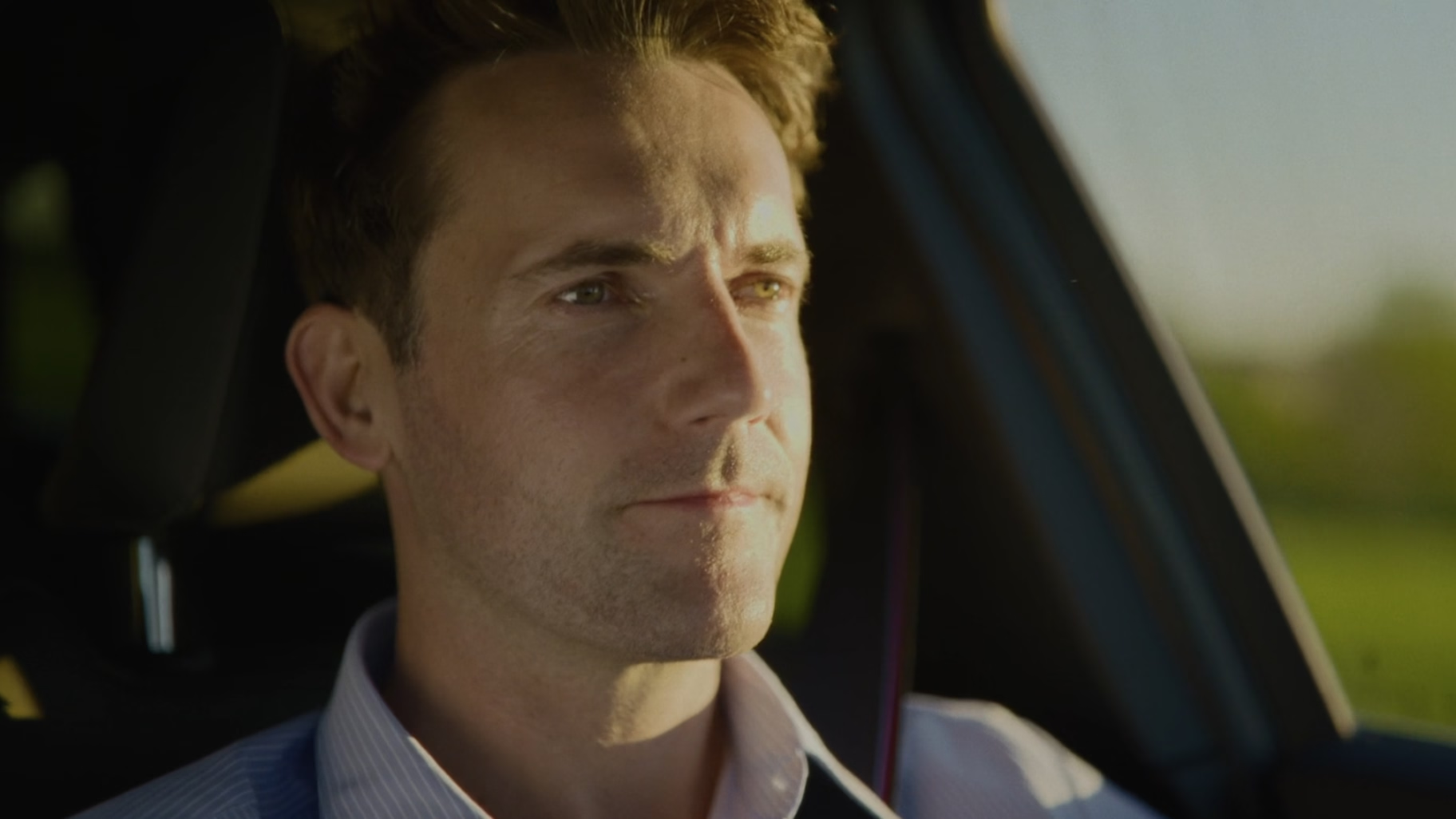
You get into your car after an intense, two-hour customer meeting. You are exhausted, your head buzzing with agreements, technical details, and tight deadlines. Technically, you should log these outcomes into the system right away. You grab your smartphone, open the mobile CRM app, wait for it to sync, and stare at an endless form with twenty mandatory fields, dropdowns, and tiny text boxes.
After two minutes of mistyping on the on-screen keyboard, you give up in frustration. You put your phone away and tell yourself the sentence every sales rep knows: I will handle this tonight on my laptop. Reality looks different: In the evening, you sit exhausted at the kitchen table, scrolling through messy notes and struggling to reconstruct the discount threshold the procurement manager demanded or the custom specs the plant lead mentioned. This tedious desk work in daily sales eats away your valuable free time and crushes motivation.
According to the State of Sales Report from Salesforce, sales reps spend an average of just 28% of their working hours actually selling.[1] The vast majority of the workweek gets swallowed up by manual admin, meeting prep, and data maintenance. When a mobile system creates so much friction that reps postpone documentation, it is not the person who fails, but the tool.
- Tedious navigation through nested mandatory fields on tiny touchscreens
- Critical details get lost between leaving the customer site and evening follow-up work
- Late-night admin at the kitchen table robs recovery time and damages sales morale
- Low mobile adoption leads to outdated customer records and duplicate effort
The true root cause of mobile CRM failure
When sales teams do not maintain their mobile CRM apps, sales leaders often mistakenly blame a lack of discipline. However, the root cause lies in the software architecture itself. Traditional CRM systems were historically designed for desktop browsers and controlling departments. Mobile CRM apps are usually nothing more than management dashboards shrunk down to smartphone dimensions. They demand the same complex data entry as a desktop monitor while offering field reps zero immediate value on site.
Industry analyses from Gartner confirm that between 50% and 70% of all CRM projects fail to achieve their intended goals.[2] Research from Forrester Research also shows that 70% of these failures stem directly from a lack of user adoption.[2] Software that feels like a monitoring mechanism and steals valuable selling time on the road gets instinctively boycotted by field sales reps.
As long as software vendors try to cram complex spreadsheet structures onto mobile screens, mobile adoption will remain low. Anyone requiring sales reps to spend ten minutes filling out forms after every meeting forces highly skilled salespeople into the role of data typists.
The Cost of Sales Data Gaps
Rejecting cumbersome CRM apps leads to severe organizational consequences. When systems cause friction in daily routines, field reps build pragmatic shadow systems: agreements end up on handwritten sticky notes, in private note-taking apps, or in messy WhatsApp chats. For the organization, this information remains invisible.
Studies show that up to 79% of all business-relevant opportunity data is never captured in the CRM.[3] When four out of five key customer insights remain outside the database, dangerous information silos emerge. If a team member changes territories or leaves the company, all of that implicit customer knowledge is lost.
These gaps hit leadership and Revenue Operations especially hard. When deals in the CRM are only maintained superficially, revenue projections turn into pure gut-feeling estimates. Just how severely incomplete CRM data impacts business outcomes becomes obvious in missed quarterly targets and misallocated resources. You simply cannot generate accurate forecasts on top of incomplete pipeline data.
- 79% of opportunity details are completely missing from the CRM system
- Revenue projections and forecasts rely on assumptions rather than facts
- Customer interaction history is permanently lost during staff turnover
- RevOps and sales leadership lose visibility into real customer needs and objections
Voice-to-CRM: The New Standard on the Go
To remove mobile adoption barriers once and for all, a paradigm shift is required: moving away from visual form fields toward natural language. With a true Voice-to-CRM approach, sales reps neither have to open an app nor type a single word.
This is precisely where phone-based Voice Agents come in. After leaving the customer meeting, the rep gets into the car and initiates a standard phone call over the hands-free system. No additional hardware, mobile data consumption, or app interactions while driving are required. The assistant leads a natural, peer-to-peer debriefing conversation.
The crucial difference compared to a simple dictation feature lies in the dialogue: your personal assistant does not just listen, but proactively asks about missing details, such as: What concrete next steps were agreed upon? Who holds budget authority? Which competitors are still in the race? Following the call, the AI extracts all the facts and populates the matching CRM fields in Salesforce, HubSpot, or Microsoft Dynamics 365 automatically.
- Wrap up the meeting, get into the car, and connect via hands-free
- Start a phone call with your personal assistant
- Conduct a structured debriefing while the assistant asks targeted questions
- Done: The CRM updates deals, contacts, and tasks with zero manual input
Transcription vs. Voice Agents: What Do You Really Need?
When looking at modern AI solutions in sales, people often assume every customer conversation must be recorded and transcribed verbatim. That is a misconception. Interactive Voice Agents and meeting transcription are two separate, modular components that can be combined as needed.
For regular CRM updates, quick status reports, and routine on-site field visits, meeting recording is completely unnecessary. In these cases, the Voice Agent is all you need: the sales rep debriefs the meeting while driving back, answers the assistant's clarifying questions, and the CRM is up to date in two minutes. This saves time and requires zero involvement from the customer on-site.
Optional real-time transcription, on the other hand, serves as a targeted upgrade for long, highly technical negotiations, such as in mechanical and plant engineering or complex IT implementations. When four technical experts spend two hours discussing specifications, the conversation is captured live. Combined with the Voice Agents, this yields not only precise CRM entries, but ready-to-send follow-up email drafts tailored exactly to the discussed requirements.
Compliance and Works Council: Why Recording Apps Are Out of the Question
Especially in the DACH region, many US sales tools fail due to strict legal requirements. Anyone in field sales who casually creates audio recordings or uses consumer dictation devices treads on dangerous ground. Under § 201 StGB, violating the confidentiality of the spoken word through unauthorized audio recordings is a criminal offense. Tools that locally buffer audio signals or archive them permanently strictly require the explicit consent of all participants.
Modern voice solutions follow a fundamentally different architecture: during live documentation, audio is processed via secure real-time streaming and discarded immediately after conversion into text. At no point does a stored audio or video file of the conversation exist. The Bavarian State Office for Data Protection Supervision (BayLDA) addressed precisely this setup in its 15th Activity Report 2025 and concluded that live transcription without permanent storage of the spoken word can generally be grounded on legitimate interest under Art. 6 (1) lit. f GDPR, provided necessity is reviewed on a case-by-case basis and only a summary, not the full transcript, is retained.[4]
This non-monitoring approach is also key to working with employee representatives. When a solution does not monitor employees, does not store voice recordings for performance evaluations, and serves purely as a personal assistant to relieve administrative desk work, works council approvals are significantly easier to obtain. ISO 27001 certification, a SOC 2 attestation, and server locations exclusively in the EU are standard proof points expected by enterprise procurement and data protection teams.
- No audio or video recording: complete compliance with § 201 StGB and GDPR
- Real-time streaming without local buffering on the smartphone
- Legally sound basis grounded in the 15th Activity Report of the BayLDA
- High works council acceptance thanks to a pure assistant and non-monitoring principle
From Frustration to Routine: How to Make the Transition
Saying goodbye to hated mobile typing masks does not require a month-long IT mega-project. While traditional CRM rollouts often eat up months and tie up external consulting budgets, moving to voice-based documentation is fast and pragmatic. Teams typically start with a standard plan and are fully operational within one to two weeks.
The Bliro platform connects seamlessly with leading systems like Salesforce, HubSpot, Microsoft Dynamics 365, and SAP. Because sales reps do not have to learn complex new app interfaces—they simply make a familiar phone call—tedious training sessions are eliminated. Team adoption is instantaneous from day one because the personal benefit is immediately clear: never again typing up reports at your desk late at night.
Field experience speaks clearly: sales teams regain significant selling time previously lost to desk work thanks to voice-based follow-ups. CRM adoption increases noticeably because every opportunity is documented without gaps. And because follow-ups happen faster and customer details are more precise, closing rates improve as well.
- Rollout in a few weeks without burdening internal IT resources
- Seamless synchronization with Salesforce, HubSpot, Microsoft, and SAP
- Significantly more selling time gained per sales rep each week
- Higher CRM data coverage leading to improved conversion rates
Sources
- https://www.salesforce.com/news/stories/sales-research-2023/
- https://oplacrm.com/6-reasons-why-crm-fail/
- https://vantagepoint.io/blog/sf/hs/crm-underutilization-fix
- https://www.dsn-group.de/datenschutz-notizen/wenn-ki-mithoert-was-unternehmen-bei-der-transkription-von-gespraechen-beachten-muessen-0759242
Your questions, our answers