AI This article was created with the help of AI.
Key takeaways
- Sales reps spend 60 percent of their working hours on administrative tasks instead of actively selling.
- True AI voice assistants require no app and work securely via a simple phone call right from your car.
- Optional GDPR-compliant real-time transcription without permanent audio storage avoids data privacy conflicts.
- Automated CRM maintenance via voice assistant saves field sales reps up to eight hours of admin work per week.
The reality in field sales: Admin backlog at the kitchen table
A long day in field sales comes to an end. You have driven hundreds of miles on the highway, held multiple intense customer conversations, and negotiated complex details. But instead of calling it a day, your second shift begins in the evening at the kitchen table: the CRM demands updates. Visit reports must be typed up, tasks assigned, and meetings followed up. This administrative overhead doesn't just steal valuable recovery time; it holds back your entire sales performance.
According to the official Salesforce State of Sales Report, sales professionals spend on average only about 27 percent of their working time actually selling.[1] More than 70 percent of weekly working hours go toward administrative tasks, meeting preparation, and manual data entry. For teams in field sales, this burden weighs particularly heavy because the desk is only reached long after working hours.
- Manual typing of meeting notes after hours
- Missing granularity in CRM fields due to time lags
- Delayed follow-up emails to prospective new clients
- Mounting frustration from duplicate logging of sales data
In practice, trying to clear this admin backlog often leads to a dangerous compromise: either data quality and forecasting suffer because notes are heavily abridged, or documentation is squeezed into brief roadside pauses during the drive.
Smartphone behind the wheel: The fatal risk of distraction
To avoid late-night typing, many field sales reps reach for their smartphone while on the move. They dash off quick messages to colleagues, adjust status fields in the CRM, or attempt to log notes in parking lots. Yet any manual interaction with a smartphone while driving or with the engine running presents immense dangers and is strictly prohibited by law.
The numbers speak for themselves: manual input while driving is not a minor infraction, but a major safety hazard. When attention shifts from the road to a screen, accident rates spike dramatically. Solutions are urgently needed that make working entirely hands-free.
The dilemma: Memory gaps versus data security
This creates a persistent dilemma for field sales reps. If you do not document the customer conversation immediately, crucial details quickly fade. After three consecutive meetings, figures, objections, and agreed next steps blur together. Relying solely on memory causes CRM data quality to plummet.
An analysis highlights that around 55 percent of all drivers regularly use their smartphone while driving, even though this is penalized with fines starting at 100 euros and penalty points according to § 23 (1a) StVO. The motivation behind this is understandable: you want to capture information before it slips your mind.[2] However, anyone who waits until the evening to document loses valuable details for sales follow-ups.
- Loss of crucial deal details due to time delays
- Incorrect mapping of customer requirements in the CRM
- Legal risks and fines from prohibited smartphone use
- Declining forecast accuracy for sales leaders and RevOps teams
Conventional methods fall short when it comes to transferring fresh customer visits into the CRM without safety risks. Neither postponing the work until late in the evening nor manual typing on the road offers a viable solution.
The Way Forward: Voice-to-CRM and the Limits of Hardware
Many sales teams test classic dictation devices or voice memo apps to record voice notes. But this approach only partially solves the core problem. A recorded audio file still needs to be listened to manually afterward, summarized, and entered by hand into fields in Salesforce, HubSpot, or Microsoft Dynamics 365. This merely shifts the administrative workload to the back office.
In addition, traditional dictaphones and recording devices raise significant data protection concerns. Storing audio documents locally on smartphones or dictation devices risks violating § 201 StGB, which protects the confidentiality of the spoken word. Downloading and caching confidential customer conversations on mobile devices poses an unpredictable shadow IT risk for enterprise IT.
A modern sales approach therefore requires systems that understand spoken words directly, structure them neatly, and operate completely without permanent audio recordings.
How True Voice Assistance in Sales Works Today
Modern AI sales assistants go far beyond basic dictation features. They act like an intelligent co-pilot in the car with whom you can speak interactively via a direct voice connection. After your customer visit, you simply place a phone call via your hands-free system.
Instead of recording monologues, the digital assistant asks targeted follow-up questions about relevant qualification criteria such as budget, decision-makers, timelines, or objections. You respond hands-free in your own words. The assistant processes the answers in real time, structures them according to your sales standards, and populates the corresponding CRM fields automatically. Professional meeting prep right before the appointment is just as seamless by voice.
- Start a phone call directly from the car (no internet connection required)
- Listen to a voice-based briefing before the customer visit
- Conduct an interactive debriefing hands-free after the meeting
- Automatic structuring and instant CRM sync in the background (Voice-to-CRM)
This voice-based workflow ensures that all information is captured seamlessly while your hands stay safely on the steering wheel and your eyes remain on the road.
GDPR-Compliant in the Vehicle: Why Streaming Makes the Difference
For European enterprises and IT leaders, data privacy comes first. To fully meet the requirements of the GDPR and works councils, leading voice assistants rely on ephemeral real-time streaming. During the phone call, the audio signal is transmitted in encrypted form to servers in the EU, immediately converted into text, and the spoken audio is discarded right away.
Foregoing permanent recordings is of central legal importance. The 15th Activity Report 2025 of the Bavarian State Office for Data Protection Supervision (BayLDA) notes regarding transcription that it is not only possible with consent, but can also be based on legitimate interest pursuant to Art. 6(1)(f) GDPR, provided a comprehensible balancing of interests including a necessity assessment takes place; as a particularly data-minimizing implementation, the authority explicitly highlights live subtitles without permanent storage along with suitable technical and organizational measures.[3]
- Transient processing without local audio storage on mobile devices
- Data processing on certified servers within the European Union
- Full compliance with ISO 27001 and SOC 2 standards
This provides sales organizations with an IT-approved solution that meets the highest data protection standards and secures acceptance across the entire team.
Phone Assistants in Practice: Your Co-Pilot for the CRM
This is precisely where specialized phone assistants come in: voice solutions built for your everyday work on the go. Vicky and Tim act as personal AI voice assistants accessible directly via a mobile call. They never call your customers; they stand exclusively by your side as your sales companion.
Before your appointment, the two assistants deliver a compact audio briefing based on previous meeting notes, CRM data, calendar entries, and emails. After the customer meeting, you conduct a natural voice debriefing while driving to the next customer. They ask intelligent questions, structure your visit report, and update systems like Salesforce, HubSpot, Microsoft Dynamics 365, or SAP fully automatically. Setup integrates seamlessly into existing sales workflows within just a few weeks.
- Hands-free generation of visit reports by voice right after the appointment
- Time savings of up to 8 hours per week on administrative tasks
- 10x increase in CRM adoption and data quality across the entire team
- Fully GDPR-compliant, without bots and without audio recording
Put an end to frustrating evening paperwork and increase your net selling time. Use Bliro Phone Assistants (Vicky & Tim) to complete your CRM updates safely, hands-free, and efficiently right from the car.
Sources
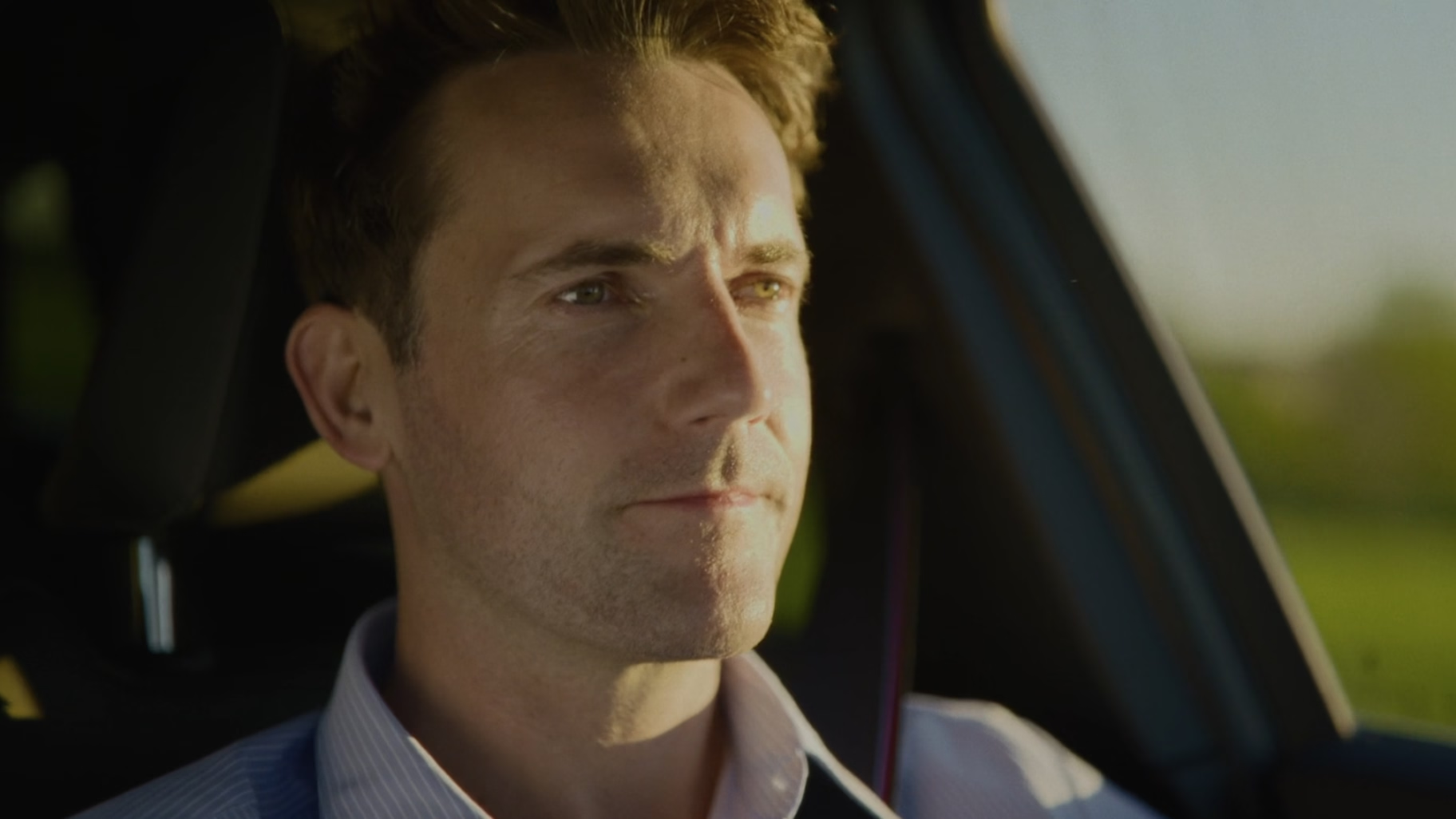
A Day in the Life of a Field Sales Rep, Powered by Bliro.
Your questions, our answers