AI This article was created with the help of AI.
Key takeaways
- According to the Forrester Activity Study, sales reps spend 72 percent of their time on administrative tasks instead of active selling.
- Bliro's Voice AI enables mobile CRM updates via a standard phone call, completely without an internet connection.
- Live transcription is GDPR-compliant and does not store audio, as confirmed by the 15th BayLDA Activity Report 2025.
- Automated capture saves 8 hours per week and ensures seamless CRM documentation in field sales.
The CRM dilemma in traditional field sales
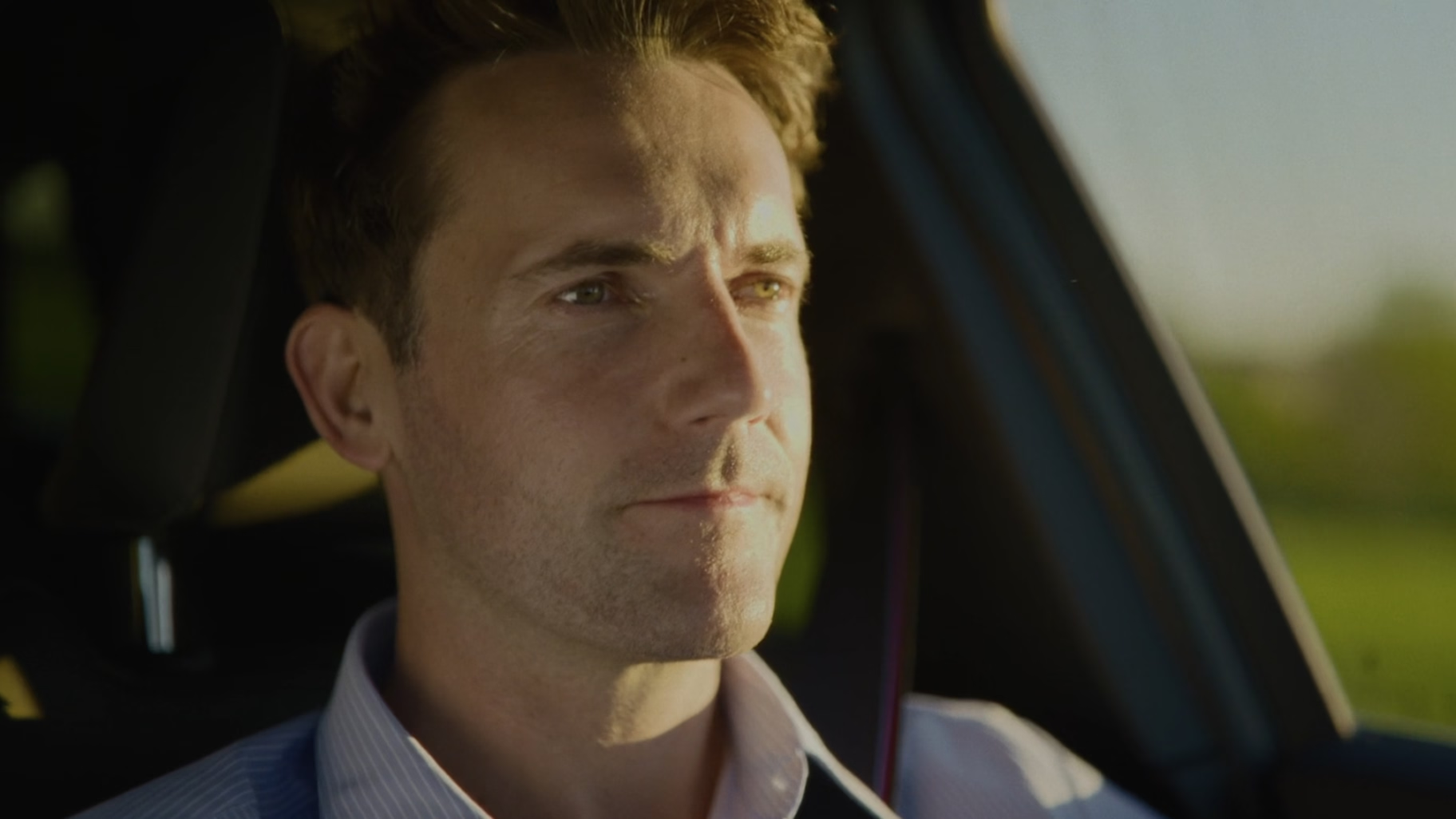
The customer meeting went fantastic. You get into the car, energy is high, and the deal is within reach. But as soon as you sit behind the wheel, the dreaded part of the workday begins. Late at night at the kitchen table, you painstakingly type up your visit reports and try to reconstruct missing details from your notepad.
This isn't an isolated case - it's daily reality for many sales teams. According to the Forrester Activity Study, sales reps spend a staggering 72 percent of their work time on non-sales tasks like CRM maintenance, internal admin, and research.[1] Instead of actively selling, most work hours sink into manual data entry.
- Lost details: Crucial agreements fade away on the drive to the next appointment.
- Evening frustration: Administrative desk work regularly spills over into your evening.
- Declining CRM usage: Incomplete data leads to inaccurate forecasts and flawed pipeline analyses.
Specific methods to automate visit reports thus become the decisive lever to get data quality back on track and noticeably relieve your field reps.
Why classic AI notetakers fail in the field
In recent years, numerous software vendors have launched AI notetakers. What works in video conferences at the office quickly hits hard limits in field sales. Classic tools were built for fixed online meetings, relying on constant internet connections and visible meeting bots.
In field sales, reality looks completely different. During customer visits in industrial parks, underground garages, or rural areas, cellular connectivity frequently drops. Reliable capture without permanent Wi-Fi is therefore critical to whether a mobile tool gets accepted in the field. When connection fails in conventional apps, capture stops entirely.
Furthermore, pure dictation devices may capture spoken text, but they don't deliver structured fields for the CRM. When sales reps still have to transcribe raw audio files, the administrative burden remains.
CRM updates via phone call: How Vicky and Tim work
This is where AI voice agents Vicky and Tim come in. They act as your personal assistants on the phone and can be contacted with a simple phone call. You dial the number right from your steering wheel - no opening apps or typing on your smartphone required.
Communication happens naturally via voice while driving. You simply report how the conversation went to Vicky or Tim in your own words. For you, it remains a standard phone call: no app, no typing, no admin backlog in the evening. Inside sales teams use the exact same approach when they need to quickly log updates into the CRM after an online meeting.
- Hands-free capture: Dictate meeting results right after pulling out of the parking lot.
- No internet dependency: Works over normal phone connections, even in cellular dead zones.
- Targeted follow-up questions: The voice agent proactively asks for key deal criteria if information is missing.
Through this seamless interface, your car becomes a productive workspace without compromising road safety or your focus on driving.
The Voice-to-Voice Workflow Before and After Meetings
The workflow covers the entire span before and after every customer visit. Before the appointment, you call your AI assistant to receive a concise audio briefing. The system pulls interaction history, open tasks, and recent notes directly from your CRM, reading the most important facts to you on your drive there.
After the meeting, you speak your observations, agreements, and agreed next steps. Modern Voice-to-CRM translates spoken words directly into structured data fields. Sales process benchmarks confirm that standardized, guided reporting workflows noticeably optimize the overall duration of field visit activities.
- Step 1 (Before the meeting): Voice-based briefing with CRM context during the drive there.
- Step 2 (After the meeting): Speak all results freely while sitting in your car.
- Step 3 (Automatic sync): The CRM updates fields, tasks, and follow-up draft emails.
Before you even arrive at your next destination, follow-up email drafts are prepared for the client and your CRM pipeline is completely up to date.
Criminal Law Risks: The Trap of Section 201 StGB
When deploying AI in customer interactions, strict legal guidelines must be observed. Many market solutions rely on recording devices or temporarily store audio signals. In Germany, Section 201 StGB (violation of the confidentiality of the spoken word) imposes criminal liability if conversations are recorded or buffered without explicit consent from all participants.
Traditional dictation devices or meeting bots that store audio files or utilize local buffering create substantial legal risks for enterprises. Transcription instead of recording provides the critical legal distinction to reliably avoid criminal exposure and liability risks.
- Audio recording risk: Violation of Section 201 StGB without prior explicit consent.
- Caching security risk: Locally buffered audio files on mobile devices create data leakage risks.
- Legally compliant alternative: Real-time stream processing without storing the audio signal.
A privacy-first handling of conversation data not only protects your enterprise, but also builds lasting trust with your prospects and customers.
GDPR and BayLDA: Transcription Without Audio Storage
Alongside criminal law, compliance with the General Data Protection Regulation (GDPR) is paramount. The Bavarian State Office for Data Protection Supervision (BayLDA) clarified in its 15th Activity Report 2025 that live conversation transcription without permanent audio storage can be legally grounded on legitimate interest pursuant to Art. 6(1)(f) GDPR.
Because audio data is processed in an encrypted real-time stream and immediately discarded, no persistent audio files are ever created. Technical security standards such as ISO 27001 and SOC 2 Type 1 certifications independently validate this level of data protection.
All server locations are within the European Union, fulfilling the highest security requirements for German industrial and B2B enterprises.
More selling time through automated sales admin
While sales teams spend up to 72 percent of their working time on administration according to Forrester, an end-to-end sales assistant flips this ratio on its head. The decisive step is the leap from a simple note-taking app to a comprehensive sales-admin platform that automates the complete cycle of meeting preparation, notes, CRM updates, and follow-ups.
Practical results speak for themselves: users save an average of 6 to 8 hours per week, gain complete coverage of their customer data, and boost conversion rates by an average of 22 percent. Because the solution operates without recording and without employee monitoring, it can be seamlessly introduced even in companies with a works council.
- +8 hours of selling time: Significant time saved per sales rep every week.
- Complete CRM activity: Every conversation is captured and structured, enabling reliable forecasts and pipeline transparency.
- Fast rollout: Complete setup in just a few weeks without a complex IT project.
Whether you have a small sales team or a large field organization: your reps can focus fully on selling again while the sales assistant handles the administration.
Sources
A Day in the Life of a Field Sales Rep, Powered by Bliro.
Your questions, our answers