AI This article was created with the help of AI.
Key takeaways
- Sales reps spend only about 30 percent of an average working week actually selling - the rest goes to lead prioritization, data entry, and quotes (Salesforce State of Sales).
- A dictation recorder or private voice memo app creates a recording under Section 201 of the German Criminal Code (StGB) and shadow IT without a data processing agreement or IT approval.
- Only just under a quarter of companies (23 percent) have established rules for using AI tools (Bitkom, October 2025).
- An AI phone assistant fills CRM fields via a voice call from the car - without recording and without typing.
- With real-time streaming, no audio file is ever created: the audio is processed in real time and continuously discarded.
Why typing never gets faster, and what helps instead
A day you know: The meeting went well, the conversation flowed, the chemistry was right. And then you sit at the kitchen table in the evening, typing the visit report into the CRM. Next steps, budget, decision-makers, remarks. While your family finished dinner long ago, you are wrestling with mandatory fields and phrasing. Tomorrow morning brings the first meeting, and today's report still is not done.
The usual reaction to this problem is: type faster. Or use a better form. Or a template. But the time sink is not the writing itself. It is the channel. You talk during the meeting, and afterwards you translate what was said into a form with your hands. On top of that comes the double transfer effort: first you gather the information, then you enter it field by field into the CRM. Two work steps for the same data.
The numbers show how big the overall problem is: According to Salesforce's State of Sales market study, sales reps spend only about 30 percent of an average working week actually selling - the rest goes to tasks like prioritization, planning, and data upkeep.[1] Desk work in the sales day-to-day eats exactly the time you could spend selling. And it eats something else too: the quality of your CRM data. What gets typed up tired in the evening from memory is subjective, incomplete, and often two days too late for the pipeline.
So the thesis of this article is: the lever is not faster typing, but switching the capture channel. Speak instead of type. There are three buyable ways to do this: the classic dictation recorder, the voice memo app, and the AI phone assistant. All three solve the capture problem, but they differ massively in CRM integration, data privacy, and shadow IT risk. That is exactly the comparison you will make in the next sections.
- Dictation recorder: recording on hardware, transcription and typing in the evening, risk under Section 201 StGB
- Voice memo app: fast capture via smartphone, but the path into the CRM stays manual
- AI phone assistant: one voice call after the meeting, and the answers land directly in the CRM fields
Approach 1: The dictation recorder, and why it becomes shadow IT
Every field sales rep knows the classic routine: after the conversation you press the record button, speak your impressions into the device, and in the evening transfer the audio file to your laptop. Then you listen back to yourself and type the report into the CRM. The capture takes two minutes, the follow-up work twenty. So you have not saved any time - you have only postponed it.
The legal risk
The bigger problem is legal. A dictation recorder creates an audio file, which means the non-publicly spoken word is recorded onto a sound carrier. Section 201 of the German Criminal Code (StGB) makes exactly that a criminal offense: anyone who unlawfully records the non-publicly spoken word of another person onto a sound carrier is liable to prosecution.[2] Without documented consent from all conversation participants, the recording is unlawful. In customer meetings, you rarely obtain that consent in a provable way. That means not only the individual rep carries a risk, but also the company that knows about or tolerates the practice.
Shadow IT without a DPA and audit trail
The second problem is organizational. Reps buy dictation recorders and consumer recorders like Plaud privately, without IT approval, without a data processing agreement (DPA), without an audit trail. The audio files end up on personal devices and in consumer clouds, depending on the provider also on US servers. IT has no visibility, and compliance cannot prove anything in an audit. That is the definition of shadow IT. And it is more widespread than you think: in a representative survey of 604 companies with 20 or more employees, as of October 2025 only just under a quarter (23 percent) had established rules for the use of AI tools, while in 8 percent of companies the use of private AI accounts for work is widespread, and in a further 17 percent it occurs in individual cases.[3]
To be fair: there are cases where a dictation recorder still fits. If you work as a solo user without CRM obligations, deliberately dictate offline, and manage the files yourself, it is a legitimate tool. For a sales team with CRM obligations, it is the most expensive route, because it does not eliminate the rework - it legalizes it.
Route 2: Voice memo app - fast, but no CRM
The voice memo app is the modern version of the dictation recorder. After the appointment, you open the memo app on your phone, speak your notes, done. No extra device, no cable transfer. The capture itself takes seconds - and that is its real advantage.
But that is exactly where the help ends. The memo lands in a consumer app or consumer cloud, and the path into the CRM remains copy-paste. You listen to the memo in the evening and manually transfer the content into the CRM fields. So the rework moves right back to where it was supposed to disappear from: your desk. The app took over the capture, not the work. This is exactly the pattern described in the comparison of voice note apps and Voice-to-CRM: the app shifts the problem, it does not solve it.
Data protection is the third problem. Private apps without a DPA and without IT approval create the same recording problem as the dictation recorder: an audio file is created containing the non-public spoken word. Market-standard tools also buffer the audio before processing it. The same legal situation applies as with hardware recording - just with even less control over where the file actually is.
There is a clean alternative to this pattern. Professional voice memo features record the memo directly on the device, delete the recording from the device after transcription, and never store it on the provider's servers or those of its transcription provider.[4] Capture stays fast, but the audio file disappears instead of sitting in a consumer cloud. This is exactly the point where software-based solutions differ from consumer recorders, which come with their own hardware and their own cloud for the recordings.[5]
Best for: The voice memo app is the right choice if you only need a memory aid and have no CRM obligations. As soon as the data has to go into the CRM, it is only the first of two work steps.
Route 3: AI phone assistant - from the call straight into the CRM fields
The third route replaces the device with a conversation partner. Vicky and Tim are Bliro's personal AI phone assistants, and they work over a simple voice call. You call after the appointment, talk to the assistant, and the content lands structured in your CRM. No extra device, no app, no software on the laptop.
The debrief right after the appointment
The process is so simple it fits into your driving day: after the appointment, you get in the car, connect via your hands-free system, and call your assistant. The assistant runs a short debrief and proactively asks what is missing. What are the next steps? Who is the decision-maker? What budget was mentioned? Your answers go straight into the right CRM fields. That is Voice-to-CRM, and it works entirely without transcribing the conversation. The assistant asks for the information afterwards instead of recording the conversation.
CRM integration and data protection
The CRM integration is the decisive difference from the other two routes. Microsoft Dynamics 365 is generally available, plus Salesforce, HubSpot, and SAP. The assistant recognizes the relevant fields and fills them in without you opening a form. No back-filling, no field by field.
Data protection works here through a principle that produces no audio file: the audio is processed via real-time streaming and continuously discarded once the words are transcribed - no file remains, neither server-side nor locally.[4] For the legal assessment of a transcription, contract performance and legitimate interest can also serve as the legal basis alongside consent. In a corporate context, consent is tricky, because voluntariness and information obligations are hard to fulfil cleanly. What this means for you: if you rely on legitimate interest, you need a clean, documented balancing of interests and a clear restriction of purpose to the documentation.[6]
You need a provider account, but no app and no extra device. The voice call runs through your cell phone, like a call to a colleague.
The six criteria compared side by side
Three routes, six criteria. This table summarizes the comparison and gives a verdict per row on which route wins.
Two points deserve an honest assessment. First: the dictation recorder and voice memo app only save the capture, not the rework. The real time-drain, transferring everything into the CRM, remains in both cases. The AI phone assistant is the only one of the three routes that handles capture and CRM update in a single step. Second: on costs, hardware and apps look better at first glance. But the one-time purchase is misleading once you factor in the hidden costs of rework and compliance risk. Rolling out an assistant platform typically takes a few weeks and is handled by the provider, without IT having to set up a project.
When do the dictation recorder or voice memo app win? If you work as a single user without CRM obligations, deliberately dictate offline, or simply need a memory aid for yourself, they are the simpler choice. For a team with CRM obligations, they are the detour.
Which route fits which field sales setup
There is no blanket verdict, but there is a clear decision aid. The question is not which route is generally best, but which one fits your setup. These four scenarios cover most field sales realities.
- Rep without CRM obligations, pure memory aid: the voice memo app is enough. It is fast, free, and creates no rework as long as nobody has to process the data further.
- Classic field sales with CRM obligations and short conversations, for example in wholesale: the AI phone assistant alone is sufficient. The debrief via voice call asks for the key information and writes it into the CRM, with no transcription at all.
- Long, technical on-site conversations, for example in mechanical engineering: the AI phone assistant plus optional transcription. The follow-up email and CRM entry are generated directly from the transcript, without you having to type anything.
- Works council and IT: with no recording and no monitoring, employee representative approval becomes easy. The rollout runs through the provider in a few weeks, without IT having to set up its own project.
The difference between the last two scenarios matters: not every field sales team needs transcription. For short conversations with a clear structure, the voice call is enough. For long, technical conversations, the transcript pays off, because the follow-up and CRM entry are generated from it automatically. When choosing, make sure you get both and can switch transcription on specifically where it really adds value.
If you want to test Vicky and Tim for free, all you need is a Bliro account and your cell phone. The first voice call after your next appointment will show you whether your capture channel can really change.
Sources
- https://www.salesforce.com/de/sales/sales-force-automation-software-sfa/
- https://www.gesetze-im-internet.de/stgb/__201.html
- https://bitkom-research.de/news/beschaeftigte-nutzen-vermehrt-schatten-ki
- https://help.bliro.io/en/articles/7870461-does-bliro-save-audio-files
- https://www.bliro.io/de/compare/bliro-vs-plaud
- https://dsgvo-gesetz.de/art-6-dsgvo/
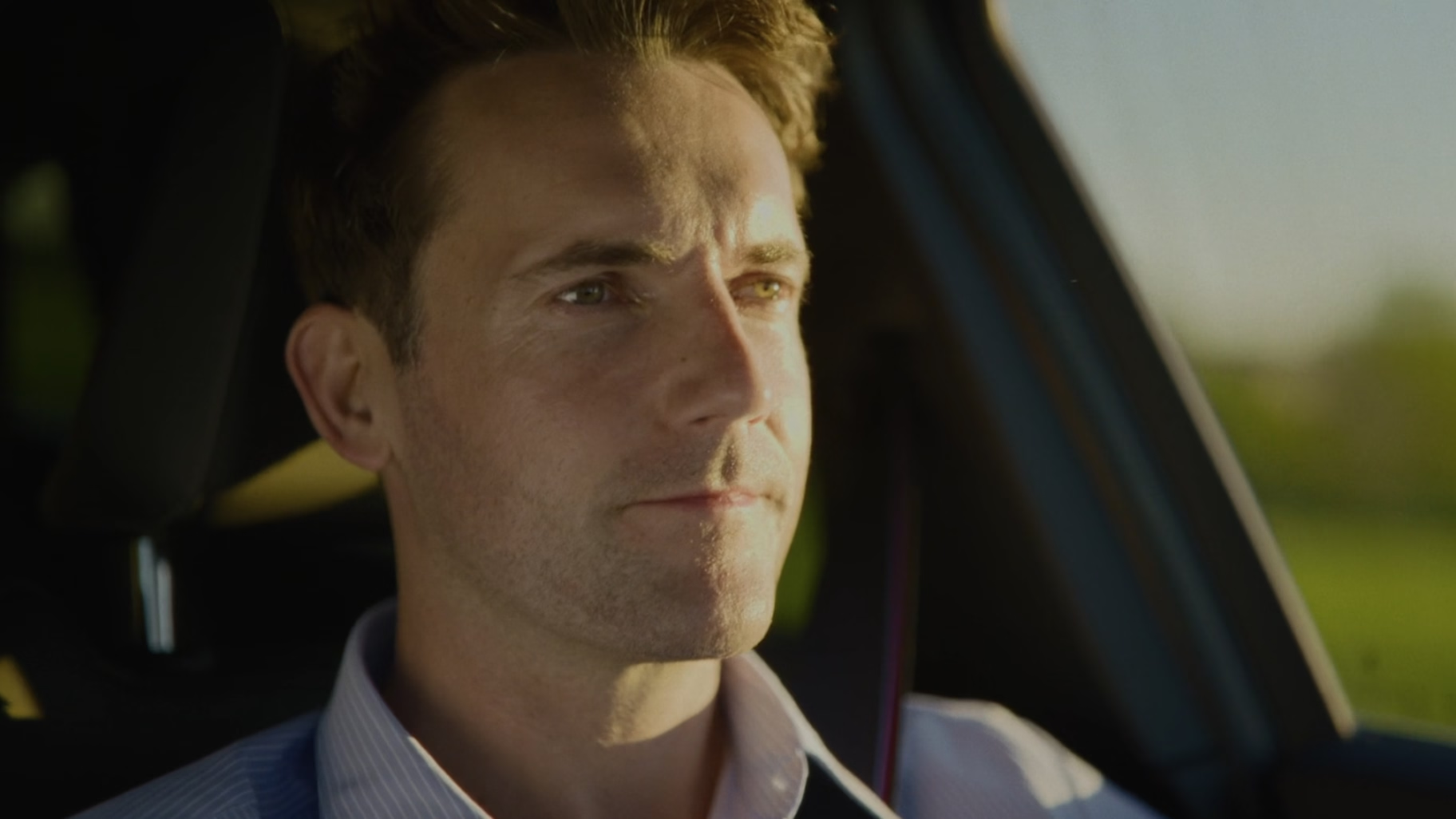
A Day in the Life of a Field Sales Rep, Powered by Bliro.
Your questions, our answers