AI This article was created with the help of AI.
Key takeaways
- CRM systems capture the wrong competitor in 65 percent of cases when reps maintain the data manually.
- A competitor mention in early deal stages increases the probability of winning by 49 percent.
- Only complete coverage of all conversations, including on-site appointments, delivers reliable market intelligence.
- Real-time streaming enables GDPR-compliant competitor tracking without critical audio recordings.
Why aren't individual competitor anecdotes enough?
Sound familiar? In the team meeting, a rep casually mentions that the customer has already spoken with another vendor. Nod, note it down, move on to the next agenda item. Two weeks later you lose the deal, and the CRM lists the loss reason as: price. A day you know well as a sales leader. The problem isn't your team. The problem is the data.
The numbers are sobering. In an analysis of around 3,000 lost deals from over 50,000 win-loss interviews, what reps entered into the CRM as the loss reason did not match what buyers actually said in 85 percent of cases.[1] And the competitor tagged in the CRM was simply wrong in about 70 percent of deals, according to a Clozd study of 1,000 lost opportunities.[2] Salesforce research across 24 companies also found 50 percent inaccurate CRM data.[2]
Why anecdotes won't save your forecast:
- They come from your reps' memory, not from the customer's actual words.
- They reach you weeks after the conversation, when the decision has already been made.
- They only reflect the deals someone happens to talk about, not the full picture.
- They can't be analyzed by segment, region, or deal stage.
The consequence: you steer your team by gut feeling instead of data. Individual conversations deliver anecdotes; only the sum of all conversations shows you the market. How that sum comes together is covered in the next section. If you want to go deeper into how conversation data becomes a clean win-loss analysis, find it here: automating win-loss analysis.
How does AI detect competitor mentions in conversations?
The technology behind it is a three-step pipeline, and it runs fully automatically in the background of every conversation. The result isn't a keyword in a note, but a structured field in the CRM.
- Capture: The conversation is turned into a transcript, online via system audio or on-site via laptop or smartphone, without a bot visibly joining the call.
- Detect: The AI searches the transcript for defined entities, such as competitor mentions. It recognizes not just the name, but the context: was the competitor mentioned as an alternative, invoked as a comparison, or evaluated as a serious option?
- Store: The mention is assigned to the right deal in the CRM and saved as a structured field or tag, ready to be analyzed across all deals.
The approach is established in the market: Gong offers competitor tracking based on recorded calls and analyzes, among other things, how mentions affect the probability of winning. The difference lies in how you get there. Tools that rely on recordings need the stored audio as their foundation. Systems with real-time transcription generate the transcript directly during the conversation, without an audio or video file ever being created. For you as a sales leader, one thing matters above all: detection is only as good as the coverage of your conversations. One transcript a week delivers no patterns; a thousand transcripts do.
How do you evaluate mentions across all conversations?
Individual mentions are noise, the aggregation is the signal. That's why it's crucial that every detected competitor mention lands centrally in your CRM - in Salesforce, HubSpot, Microsoft Dynamics or SAP - and not in your reps' memory or scattered note apps. Only when all mentions are in one place can you slice them systematically and see real patterns.
Here's what such an analysis looks like in practice: from all of a team's conversations, you can generate a competitor report that counts, per competitor, how many calls they came up in and how often - including example quotes from the transcripts. At a glance, you see which competitor is really occupying your team and in what context they appear.
The analysis questions that will genuinely help you as a sales leader:
The division of labor matters here: your reps type nothing. According to the Salesforce State of Sales study, sales teams now spend only 28 percent of their working time actually selling.[3] Don't burden those 28 percent with competitor data entry. The system handles the aggregation, you read the result. We've bundled which KPIs from conversation data are truly decision-relevant here: sales leader dashboard.
What patterns emerge per deal stage?
The timing of a competitor mention is not a footnote - it's one of the strongest signals you can extract from conversation data. The data analysis by Gong Labs shows: when a competitor is discussed early in the sales cycle, i.e. in prospecting, discovery or the first demo, the probability of winning the deal rises by 49 percent compared to deals with no competitor involvement. When the competitor is only mentioned in late stages, win rates drop and deals tend to come in smaller on average - often a sign that your reps are countering with discounts at the end.
For your forecast management, this means: late mentions are deal warning signals you would never get from CRM dropdowns, because there they only appear after the loss. From conversation data, you get them in real time, while you can still course-correct. The seven most important warning signals your forecast otherwise misses are here:.
Does competitor tracking also work without recording?
Yes - and that's exactly the decisive difference in the DACH region. Classic recording tools store the conversation as an audio file and analyze it afterwards. But that touches on § 201 StGB, the violation of the confidentiality of the spoken word: as soon as an audio signal is technically captured and stored on a storage medium, even briefly, it constitutes a recording.[3]
The approach without recording works differently: with real-time streaming, the encrypted audio signal is converted directly into text without being buffered or cached locally. After transcription, the audio is continually discarded - a permanent recording never exists at any point. The Bavarian State Office for Data Protection Supervision (BayLDA) confirms in its 15th Activity Report 2025 that such live transcription without permanent audio storage can be based on legitimate interest under Art. 6 (1) (f) GDPR.[3]
For you as a sales leader, this pays off directly:
- Your reps use the system in every conversation, without legal qualms - and only full coverage delivers meaningful competitor patterns.
- The works council is far less likely to raise the alarm: because no audio recordings are stored, no monitoring-relevant data set is created, which massively simplifies approval.
- With the customer, too, you can get sign-off on transcription more easily when no recording of the conversation is created - only a text transcript.
In short: you get the complete data foundation for your competitor tracking, without the hurdles that recordings usually create in day-to-day German sales.
Why phone calls and on-site appointments count too
Here lies the most common blind spot: teams that only analyze pure video calls at their desk lose exactly the conversations where the real competitive intelligence surfaces in field sales. The conversation at the customer's site, the phone call with the buyer, the debriefing from the car on the way to the next appointment: if these conversations don't flow into your analysis, your CRM picture stays systematically incomplete - precisely in the segment that often accounts for the lion's share of deals in B2B industrial business.
You know the consequence from your quarterly reviews: the competitor who has come up in every second on-site appointment for months never shows up in your analysis, because those conversations were never captured. Your conclusions from online meetings alone are then skewed.
- On-site appointments: capture via laptop, iPhone or iPad directly at the customer, without recording, GDPR-compliant.
- Phone calls and drive time: follow-up via voice call through the hands-free system, without an internet connection, without an app at the customer's site.
- Online meetings: capture via system audio, with every common tool, without a visible bot.
That's exactly what the Phone Assistants Vicky and Tim were built for: your reps call their personal assistant like a colleague, from the car or the parking lot, and talk through the meeting outcome. We show step by step how AI voice agents document on-site appointments here: AI voice agents in field sales. You'll find the solution for field sales here: Bliro for field sales.
The path from mention to CRM field with Bliro
Let's bring the threads together. You need four things to turn competitor mentions into data you can actually steer by: capturing every conversation, automatic detection of mentions, structured storage in the CRM, and analysis without manual data entry. Bliro maps exactly this path for customer teams: the AI assistants filter the competitor mentions out of every conversation, online and on-site, via real-time transcription without recording, and push them straight into the right CRM fields - as an official partner of Salesforce, HubSpot, Microsoft Dynamics and SAP.[4]
The mention then doesn't land in a note, but as a structured field on the deal - analyzable by segment, region and deal stage. The Voice-to-CRM principle behind it: spoken words are detected through speech recognition and semantic interpretation and written as a field value via the CRM API, instead of disappearing as free text in a notes field.[5]
What this means concretely for your team:
- A 10x increase in CRM utilization, because the data flows into the system on its own instead of by hand.[4]
- Around 8 hours less desk work in the sales day-to-day per rep and week.[4]
- 22 percent higher conversion rates on average.[4]
- Coaching and market steering based on objective conversation data instead of subjective after-the-fact reports - anonymized and without monitoring.
Your reps sell, Bliro does the rest: preparation with CRM context, notes during the conversation, competitor mentions and follow-ups automatically into the CRM. If you want to see what this looks like for your team, book a demo with the Bliro team: Book a demo.
Sources
- https://www.revenueoperationsalliance.com/85-of-your-crm-loss-reasons-are-wrong/
- https://elevatedsignal.com/insights/win-loss-analysis/
- https://www.bliro.io/de/blog/transkription-statt-aufnahme-wie-vertriebsteams-jedes-gesprach-erfassen-ohne-audio-zu-speichern
- https://www.bliro.io/
- https://www.bliro.io/de/blog/voice-to-crm-erklart-per-sprache-kundengesprache-2026-direkt-ins-crm-bringen
- https://www.gong.io/
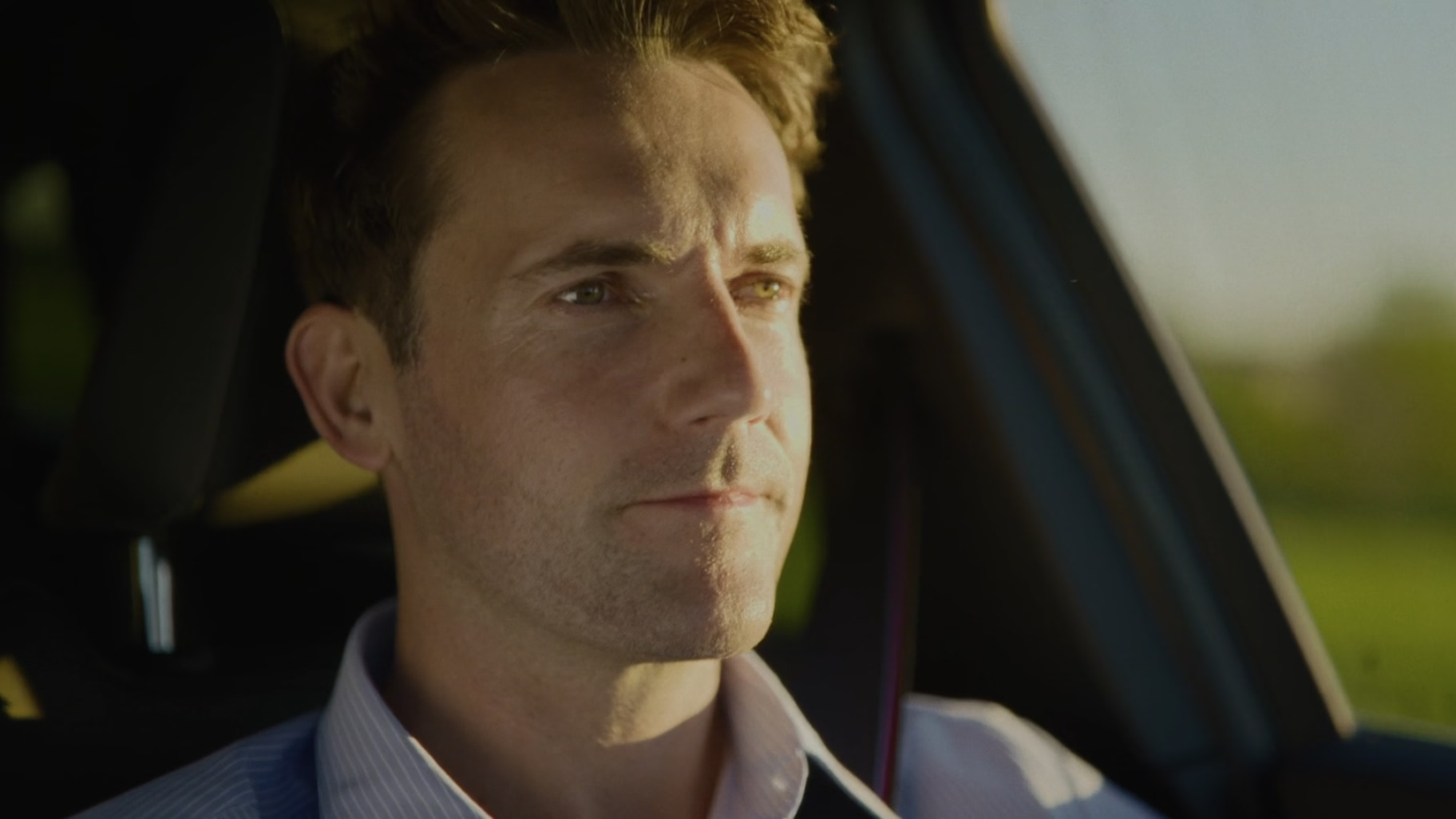
A Day in the Life of a Field Sales Rep, Powered by Bliro.
Your questions, our answers