Companies with happy employees are up to 21% more productive - this figure shows why well-trained sales teams are your most valuable asset. Sales coaching has developed from a classic “salesperson” to a “trustworthy advisor” - and is now crucial for sustainable sales success.
The figures speak for themselves: People who write down their goals and systematically pursue them are 42% more likely to achieve them. Regular coaching continuously improves skills - regardless of current performance level.
Discover eight proven strategies for effective sales coaching. These methods promote the individual skills of your sales reps and strengthen the entire team at the same time. From systematic conversation analysis to modern coaching technologies - find out how you can establish a sustainable learning culture and achieve measurable success.
What is sales coaching and why is it crucial?
Sales coaching is becoming the most effective method for continuous employee development. The approach focuses on sustainable behavioral change and personal development - far beyond traditional knowledge transfer.
Definition and differentiation from sales training
Sales coaching improves sales reps' skills, knowledge, and performance through continuous processes. Classic sales training provides theoretical knowledge and basic sales techniques. Coaching, on the other hand, focuses on individual development and practical implementation.
Sales training forms the foundation - it teaches sellers the basics of how to sell a product. Coaching is the additional level with continuous activities and individual support for specific skill improvement and successful sales behavior.
The difference is clear in the approach: Sales training works like a classroom scenario with identical content for all participants. Sales coaching is similar to personal support with a focus on individual needs.
Tools like Bliro for conversation analysis illustrate this difference. They provide deeper insights into the actual conversation between individual sellers and provide starting points for tailor-made development measures.
Benefits for employees and companies
Effective sales coaching offers measurable benefits at all levels. Sales people develop individual strengths and eliminate personal weaknesses. They gain more self-confidence and sovereignty when talking to customers, improve communication skills and questioning techniques, and achieve higher closing rates.
Companies benefit just as significantly. Sales representatives with regular coaching achieve up to 16.7% higher sales growth than teams without coaching. In high-performance sales organizations, where more than 75% of employees achieve their goals, managers invest significantly more time in coaching activities than in average teams.
Coaching promotes self-management through an analytical and process-accompanying approach. The coach helps employees find and implement their own solutions. This method leads to more lasting behavioral changes than pure training measures.
Productivity increases through direct coaching at work. This minimizes downtime and maximizes practical relevance. Recommendations for action are directly applied in daily work, not just discussed theoretically.
Long-term impact is achieved through an ongoing process rather than one-off events. Experienced coaches agree on specific tasks and goals, which will be reviewed at the next appointment - an approach for sustainable development.
Coaching improves overall corporate culture. It strengthens internal communication and team cohesion because each individual better understands why and how they should perform their tasks. This common orientation creates more productive and harmonious work environments.
Combine both approaches for maximum success. Utilize trainings as a basis and supplement this with individual coaching for continuous performance improvement of each individual seller.

Strategy 1: Understanding coaching as a management task
Sales management is fundamentally changing: from a classic instructor to a supporting coach. This development is not an option, but necessary for sustainable sales success in the complex business world.
Why managers should coach
Forming different personalities into a powerful team - that is the central challenge in today's sales department. Control gives way to supporting independent action. Sales managers must redefine their role as team leaders.
The Gallup “Engagement Index” shows alarming figures: Only 13% of German employees are emotionally attached to their company, while 66% do service in accordance with the regulations and 21% behave destructively. The economic damage: approximately 123 billion euro per year.
Managers with effective coaching achieve measurable results:
- Teams achieve 28% higher win rates
- Odds performance improves by 21.3%
- Respond faster to market changes
Many sales managers see coaching as a challenge. A Harvard Business Review study shows: Managers mistakenly believe they're coaching - they're just giving instructions. Managers must understand coaching as a central management task.
Coaching vs. instruction: The subtle difference
The key difference lies in the approach. Instructions tell you what to do. Coaching enables employees to find solutions and make decisions themselves.
Timothy Gallwey defines: “Coaching is the key to unleashing a person's potential.” Good leaders don't just deliver results - they unleash the potential of every team member.
Practical implementation:
- Switch to transformational leadership: Inspire and motivate your team instead of just managing numbers.
- Encourage personal responsibility: Let team members make decisions themselves. Signal: “Decide what is right for you!”
- Establish an error culture: Create an atmosphere in which employees provide beneficial feedback and see mistakes as learning opportunities.
Effective coaching conversations follow a clear pattern: “What do you want to achieve by when you tackle the problem (goal)? How do you want to achieve your goal (solution ideas)? What are you going to do to actually implement your solution (measures)?”
Sales managers must not only be able to take on the coaching role - they must do it temporarily in order to effectively support employees. With constantly changing market and customer behavior, sales success depends on sellers acting flexibly, creatively and authentically.

Strategy 2: Improve feedback through conversation analysis
Objective feedback forms the basis of successful sales coaching. Data-based conversation analysis replaces subjective impressions with precise insights and makes continuous improvement measurable.
Using tools such as Bliro for conversation analysis
Sales managers bump into manual conversation analysis quickly reaching limits. AI-powered tools remedy this and automatically analyze sales interactions.
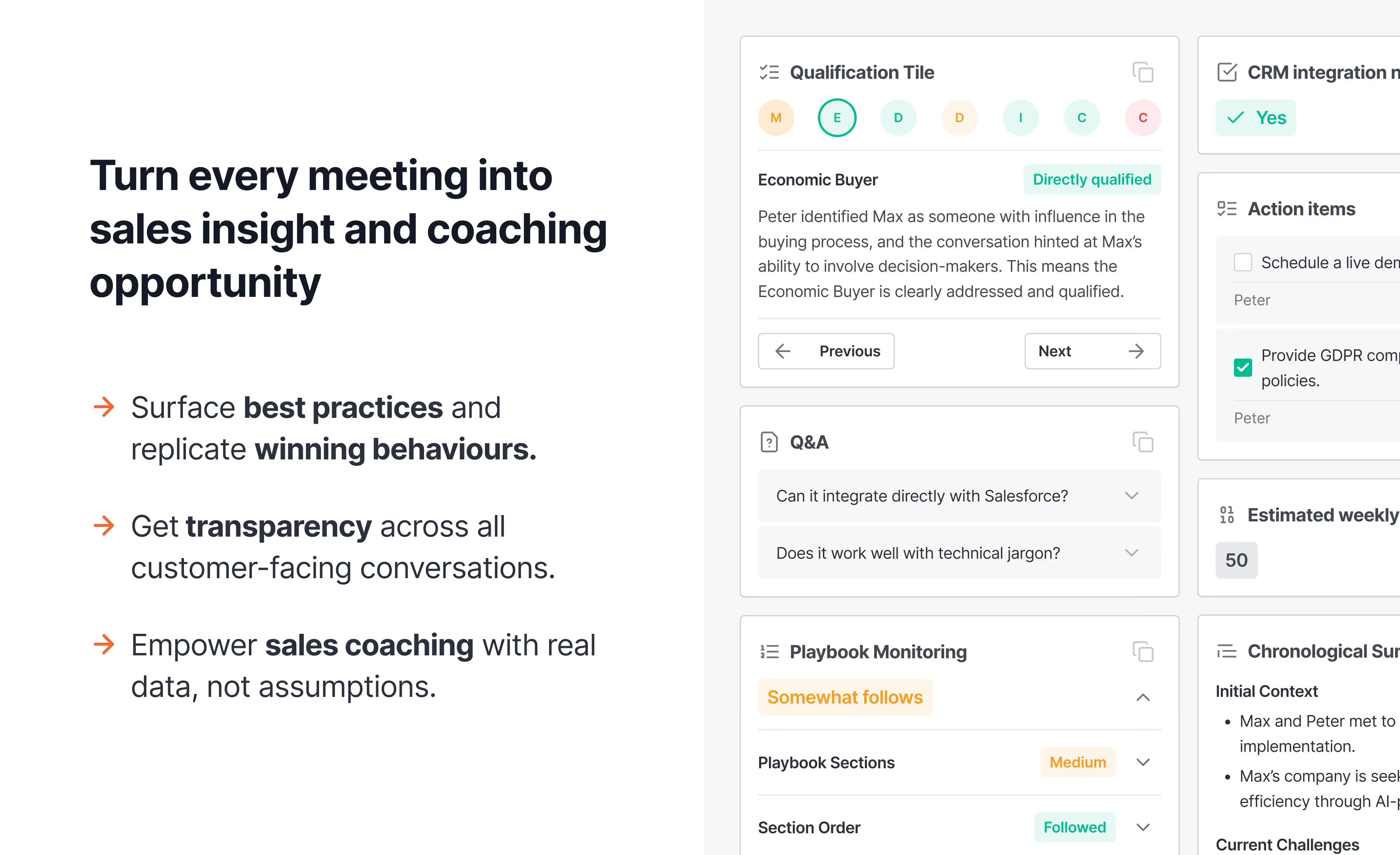
Bliro transforms sales calls into concrete recommendations for action. The system identifies important discussion moments, such as needs assessment, complaint handling and closing phases.
The measurable benefits of systematic sales pitch analysis:
- Identify successful patterns: AI recognizes the most effective strategies as best practices for the entire team
- Objective performance evaluation: data-based feedback on speech percentage, response time and convincing language
- Unlimited scaling: Thousands of employees are coached at the same time - regardless of team size or location
- Customization: Learning paths adapt to each salesperson's specific strengths and weaknesses
Achieve teams with AI-powered sales coaching to 57% higher success rates than competitors. Completion rates improve by up to 30%.
Give and accept constructive feedback
Data-based feedback requires the right communication. Constructive feedback follows best practices.
Use the ego form and refer to specific, observable behaviors. Separate the behavior from the person and explain the impact on the team or project.
Structured methods such as the WWW technique (perception-effect-wish) or COIN method (context-observation-impact-next) make feedback conversations more constructive. Your feedback should suggest concrete improvement options or work them out together.
Feedback recipients should actively listen and share their own point of view. Arrange specific measures and dates for follow-up discussions.

Strategy 3: Encourage self-reflection and personal responsibility
Successful salespeople develop a crucial skill: honest Self-reflection. This makes it possible to learn from failures and improve future sales calls. Self-reflection not only helps sellers critically evaluate their own performance, but also to better understand customer rejections.
Self-assessment questions
Self-assessment offers decisive advantages for both salespeople and managers. Employees can reflect on their performance and set goals, while supervisors gain insights into motivation, satisfaction, and potential for improvement.
Structured self-reflection in sales is based on specific questions:
- Preparation: How thoroughly did you prepare for the sales pitch? Has customer information been specifically researched?
- Relationship building: Was there a basis of trust with the customer? Did you really get involved with the interlocutor?
- Listening ability: Did you actively listen or put your own ideas in the foreground?
- Needs analysis: Were open questions asked to identify customer needs?
- Interviewing: Have you used strategic breaks? Silence helps to learn more about the other person.
- Building trust: What security did you provide to the customer? How do you set yourself apart from the competition?
- Appreciation: Did you recognize the customer for their ideas or visions?
- Follow-up: How specific were appointments made? Have promises been kept?
Tools such as Bliro support this self-evaluation through objective conversation analysis. The automatic evaluation reveals blind spots that are often overlooked during subjective evaluation.
Establish reflection routines in the team
Sustainable sales improvements require systematic integration of reflection into everyday team life. Proven routines create structure:
Daily reflection: Write down successes at the end of the day and define goals for the next day. This routine promotes focus and continuous learning.
Team analysis rounds: Analyze current routines together. Identify what works and where there is potential for improvement. Question: Which routines support us, which restrict us?
Feedback loops: Get regular feedback on new methods. This ensures that the desired effects occur and can adjust them if necessary.
Integrating the team into reflection processes increases acceptance and commitment to new routines. Bliro's AI analysis features provide objective data about conversation patterns as a basis for team discussions.
Strategy 4: Individual Objectives and Action Plans
Structured goals and concrete action plans form the basis of successful sales coaching. While self-reflection shows the current situation, clear goals define the desired results - action plans pave the way there.
Develop SMART goals together
Employees deliver 77% higher performance when they understand goals and what they mean for their work Sales goals should therefore be developed together, not simply specified.
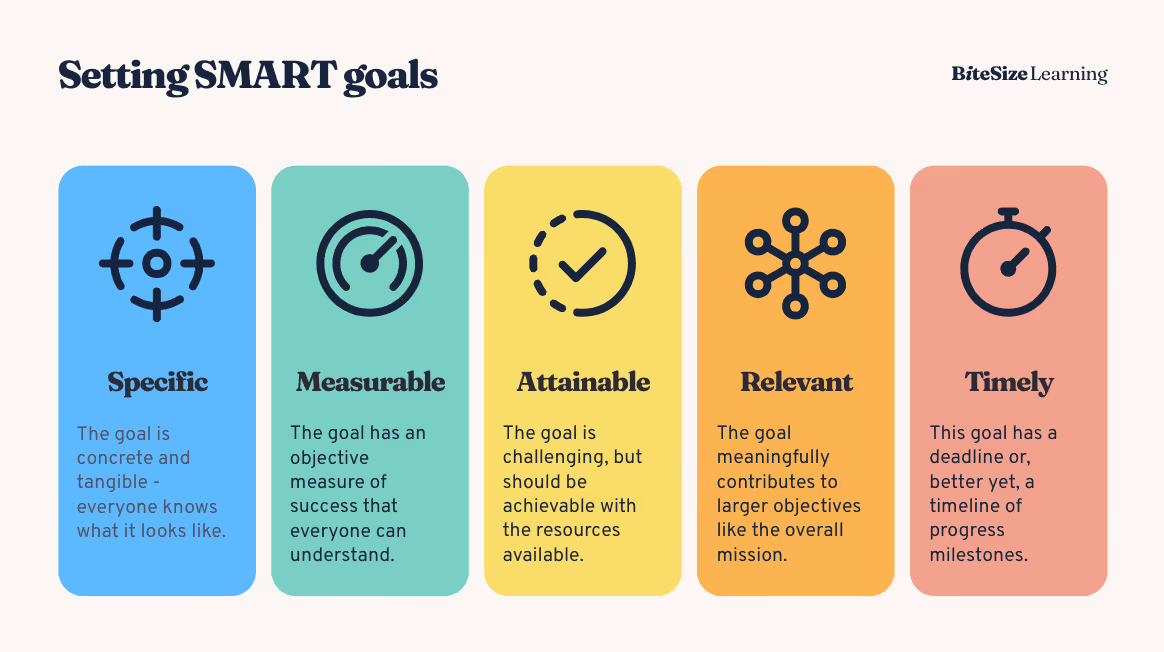
SMART goals have been tried and tested for over 40 years and are indispensable in sales. The framework includes:
- Specific: Specific, unambiguous wording. “Acquire three new major customers in the automotive sector” instead of “Acquire more new customers.”
- Measurable: Objective success indicators such as a percentage increase in turnover or the number of transactions.
- Attractive: The goal must be desirable and match the seller's values.
- Realistic: Challenging but achievable. Unrealistic goals demotivate.
- Scheduled: Clear time frame for progress measurement and planning.
Sales goals must be accepted by employees and supported by supervisors. This coordination creates common understanding and ensures uniform orientation.
Action plans with defined milestones
An action plan is more than a task list - it is a strategic roadmap for achieving SMART goals. Are particularly effective Mutual Action Plans (MAPs), which align all participants' goals.
Effective action plans include:
Define milestones: Divide the process into specific stages - from initial contact to contract conclusion. These checkpoints motivate and keep you on track.
Define timelines: Detailed deadlines for every task create commitment. Timing reduces delays and accelerates sales cycles.
Clarify responsibilities: Clear distribution of tasks minimizes misunderstandings and ensures that everyone understands their role.
Determine priorities: Start with activities that have the biggest business impact. This prioritization optimizes the use of resources.
Include check-in points: Regular progress checks enable timely adjustments.
A well-thought-out action plan enables targeted navigation through purchasing processes and optimizes the journey for all parties involved.
Breaking down major goals into specific activities shows the competencies required for individual tasks. As a result, coaching can be aimed specifically at skills that sellers need for successful action plan implementation.
Strategy 5: Coaching for everyone
Why coach your best salespeople? This question surprises many sales manager. In fact, research shows that a holistic coaching strategy that covers all levels of performance leads to significantly better Sales results leads.
Why top performers should also be coached
Top performers in sales have distinctive personality traits, skills, and strategies that set them apart from average salespeople. These top performers rarely rest on their successes - they are actively looking for new methods to ensure their knowledge advantage.
Modern sales coaching starts right here. Top performers benefit in particular from individual support:
- Existing strengths can be further expanded
- New sales techniques are being adapted more quickly
- As multipliers, they pass on knowledge to team members
The biggest opportunity for improvement often lies in the “midfield.” A performance increase of just 1% at 60% The average salesperson can have a huge impact on overall sales.
Develop sales team holistically
A well-trained sales team is the key to continuous success. Companies that establish a culture of sales excellence ensure that all sales people - not just the weaker ones - are motivated and perform at their best.
Several factors are decisive for this holistic development:
Coaching should be anchored as a strategic goal in the company. In teams that are described as “very happy,” 89% of respondents see satisfaction as a clear strategic goal.
Effective sales coaching includes various approaches: team coaching for motivation, peer coaching for mutual learning, and project coaching for specific challenges.
Bliro effectively supports this holistic development approach. The software not only identifies development potential, but also enables the analysis of successful conversation patterns among top performers as a role model for other team members.
Only when the entire sales team benefits from such solutions is an environment created in which continuous learning becomes the norm - the basis for sustainable sales success.
Strategy 6: Make progress measurable
Without clear figures, your team navigates like a ship without a compass. Measurement is not just control - it is the strategic lever for continuous optimization of your sales activities.
Important KPIs in coaching
Certain key figures show actual coaching success:
- Completion rate: Direct indicator of coaching effectiveness - shows how many conversations result in completion.
- Sales cycle duration: Shorter cycles signal increased efficiency from initial contact to completion.
- Lead quality: Evaluates the transfer of prepared contacts into the sales process.
- Upselling rate: highlights exploited potential in existing customer business.
KPI measures complement these measures to improve self-effectiveness and communication. Tools such as Bliro provide precise insights into the conduct of the conversation through automated conversation analyses and enable an objective evaluation of coaching progress.
Linking coaching and sales performance
The ROI (return on investment) makes the connection between coaching and sales performance visible. Important: Consider not only direct sales increases, but also indirect effects such as more efficient processes or higher customer satisfaction.
Regular progress monitoring is essential for:
- Increasing motivation through visible success
- Flexible adjustment of the coaching process to changing requirements
- Securing sustainable success in the long term
Continuous measurement of coaching success is your strategic lever to actively shape the future of your sales department.

Strategy 7: Establish continuity and a learning culture
Sustainable sales success is achieved through a systematic learning culture - not through one-off training sessions. Sales coaching should start with the arrival of new employees in order to build up skills in a targeted manner and avoid mistakes.
Establish structured coaching sessions
Successful sales teams follow a clear coaching rhythm instead of random interventions. A systematic approach ensures that all employees benefit equally. This coaching calendar has been tried and tested:
Daily coaching: Short pulse checks and spontaneous questions promote continuous learning.
Weekly coaching: Monday check-ins, Friday reflections and targeted skill workshops develop specific competencies.
Monthly coaching: Goal discussions, performance reviews and strategic planning provide long-term orientation.
Integrate coaching into corporate culture
Effective learning culture is created through values, practices and structures that promote continuous development. This culture does not develop by itself - it must be actively shaped.
Psychological safety and open communication are crucial. Teams that take risks and see mistakes as learning opportunities create a natural exchange of knowledge. Communication is the key.
Managers act as role models and learning guides who create framework conditions for independent learning. Bliro supports this cultural change through objective data bases for constructive feedback and promotes a continuous improvement culture.
Conclusion
Sales coaching is a continuous process that delivers measurable sales success. These seven strategies form a tried and tested toolkit for the systematic development of your sales team.
Coaching starts with the right leadership attitude. Data-based conversation analyses using tools such as Bliro enable objective feedback and precise identification of potential for improvement. Self-reflection and individual objectives ensure that every salesperson knows their personal development areas and works specifically on them.
A common mistake: limiting coaching to low-performing employees only. In fact, all team members benefit from targeted support - top performers as well as the midfield. Measurable monitoring of success through clear KPIs and the establishment of a continuous learning culture is crucial.
Bliro's AI-supported conversation analysis makes coaching scalable and provides objective data for data-based decisions.
Success lies not in individual sales techniques, but in the consistent implementation of these seven coaching strategies. Start systematically developing your sales team today.